Brief Overview

Bachelor of Business Administration (Honours) – BBA (Honours) – Advantage CMA

Lorem Ipsum is simply dummy text of the printing and typesetting industry. Lorem Ipsum has been the industry's standard dummy text ever since the 1500s, when an unknown printer took a galley of type and scrambled it to make a type specimen book.

PEO (Program Educational Objectives)

PEO 1: Foundation in business knowledge:

To provide students with a solid foundation in core business areas, including accounting, finance, marketing, management, operations, and other business functions. To develop a broad understanding of the fundamental concepts and principles of business.

PEO 2: Critical thinking and problem-solving skills:

To cultivate students' critical thinking abilities and problem-solving skills. To equip them with competencies to analyze business challenges, evaluate options, and develop effective solutions using logical reasoning and data analysis.

PEO 3: Effective communication skills:

To develop students' oral and written communication abilities, including presentation skills, business writing, and interpersonal communication.

PEO 4: Teamwork and collaboration:

To emphasize the importance of teamwork and collaboration in the professional world. To encourage students to work in teams, develop leadership skills, and effectively collaborate with others to achieve common goals.

PEO 5: Entrepreneurial mindset and innovation:

To nurture students to develop an entrepreneurial mindset and foster innovation. To cultivate creativity, risk-taking, and an ability to identify and seize business opportunities.

PEO 6: Lifelong learning and professional development:

To promote a mindset of lifelong learning and continuous professional development. To encourage students to stay updated with industry trends, pursue further education or certifications, and adapt to the evolving business landscape.

PSO (Program Specific Outcomes)

Area of Marketing:

Aligning students’ learning of ‘Marketing’ within the broader perspectives of ‘Business Management’.
Enabling students to understand and apply the fundamentals of this course as future managers in the ambit of ‘Marketing’.
Establishing vivid overlaps across multiple functions for an effective and multidisciplinary understanding and application of the course.
Enabling students to adapt to the marketing environment and standards, and thereby, orienting them for professional roles in the industry.

Area of Finance & Accounting:

To enable the students in applying the fundamental knowledge of Accounting & Finance domains for providing financially viable business solutions.
To equip the students with skills required to operate in a competitive environment understanding the roles and functions of   various finance activities of an organization.
To develop competent finance professionals and acquire skills to adapt to trends and changes in the business environment.

Area of Human Resource Management:

To understand the link between business and human resource management.
To expose and develop an understanding of the role and functions of various human resource activities in an organization.
To enable students to acquire skills to adapt to trends and changes in the business environment.
Area of Information Systems & Operations Management:
Equip the students with various skill sets to analyse and evaluate a situation from operations’ perspective and measure it
To develop professionals who can understand, evaluate and implement technology solutions to social or business problem
To develop a professional who can provide solution to the business problem taking into account the various angles and emerging technologies which are continuously disrupting the business functions.

Area of General Management:

To provide the fundamental skills and knowledge required to undertake/ and assimilate the specialized courses in Management.
To initiate the students to learn and apply the knowledge and skills of Management in a broad spectrum of business situations.
To inculcate the understanding of Management as a cross-disciplinary area of expertise.
To develop advanced levels of technology and specialized skills that will be applicable across functional areas

PO (Program Outcomes)

Business Knowledge:

Graduates will demonstrate a comprehensive understanding of core business concepts, theories, and practices across various functional areas.

Problem Solving:

Graduates will demonstrate the ability to identify, analyze, and solve complex business problems using appropriate research methods, data analysis techniques, and strategic thinking.

Critical Thinking:

Graduates will exhibit the ability to analyze and evaluate complex business problems, apply logical reasoning, and make informed decisions.

Communication Skills:

Graduates will possess effective oral and written communication skills, enabling them to convey ideas, present information, and negotiate effectively in professional settings.

Business Law and Ethics:

Graduates will exhibit a sound understanding of business laws and regulations, ethical considerations in business decision-making, and corporate governance principles.

Leadership Skills:

Graduates will develop leadership qualities, including the ability to motivate and inspire teams, adapt to change, and solve problems in a collaborative manner.

Entrepreneurial Mindset:

Graduates will possess an entrepreneurial mindset, demonstrating creativity, innovation, and the ability to identify and capitalize on business opportunities.

Embracing Universal Human Values:

Graduates will integrate universal human values, such as truth, righteous conduct, peace, love, nonviolence, and scientific temper, into their personal and professional lives, fostering a culture of integrity and social responsibility.

Technology Competence:

Graduates will be proficient in utilizing relevant business technologies, data analytics tools, and digital marketing platforms.

Teamwork and Collaboration:

Graduates will exhibit effective teamwork and collaboration skills, working cooperatively in diverse groups to achieve common goals and objectives.

Global Perspective:

Graduates will have an understanding of global business environments, including cultural diversity, international trade, and the impact of globalization on business operations.

Professional Development:

Graduates will exhibit a commitment to lifelong learning, continuously updating their business knowledge and skills, and adapting to evolving industry trends and practices.

Curriculum Structure

Year 1
Semester-wise Syllabus

Semester I

  • Foundation of Business English
  • Hindi / Kannada / French / Spanish / German - 1
  • Principles and Practices of Management
  • Fundamentals of Accounting
  • Fundamentals of Economics
  • Banking & Financial Literacy
  • Universal Human Values
  • Quantitative Basics for Business *
  • Communicate to influence – building connections*
  • Club Activity*

* Audit Courses

Semester II

  • English for Business Communication
  • Hindi / Kannada / French / Spanish / German - 2
  • Business Mathematics and Statistics
  • Corporate Finance
  • Health and Wellness
  • Sociology**
  • Psychology **
  • Indian Political System**
  • Quantitative Foundations for Business*
  • Speak to Lead- Elevate your Interpersonal skills*
  • Club Activity*

* Audit Courses
** Any two courses out of the three electives need to be chosen

Year 2
Semester-wise Syllabus

Semester III

  • International Business
  • Investment Decisions
  • Marketing Foundation & Framework
  • Financial Statement Analysis
  • Organization Behavior
  • Spreadsheet Modelling
  • Quant for Career Building*
  • Lead with agility – Thriving through change*
  • Club Activity*

* Audit Courses

CMA Value Added Course
Risk Management & Professional Ethics

Semester IV

  • Marketing Application & Practice
  • Human Resource Management
  • Decision Analysis
  • Financial Reporting Decisions
  • Supply Chain Management
  • Environmental Science
  • Quant for Career Advancement*
  • The mindful Leader- Aligning Goals with Purpose*
  • Club Activity*

* Audit Courses

CMA Value Added Course
Internal Control
Year 3
Semester-wise Syllabus

Students need to select a Functional Track for Sem V, VI, VII, VIII and a Practice track for Sem V, VI

SEMESTER COURSE
SEMESTER V Performance Management
Functional Track Elective - 1
Practice Track Elective - A
Practice Track Elective - B
Internship 
Club Activity* 
Functional Track Functional Track Course
Marketing Elective 1 - Marketing of Services
Finance Elective 1 - Financial Markets and Services 
Human Resource Management Elective 1 - Recruitment and Selection 
Operations Management Elective 1 - Innovation and Emerging Trends in Technology
International Business Management Elective 1 - EXIM Trade
Business Analytics Elective 1 - Analytics for Business
Fintech Elective 1 - Fintech Fundamentals
Practice Track Practice Track Course
Digital Marketing Elective A - Social Media Marketing 
Elective B - Search Engine Optimization & Marketing 
Financial Analytics Elective A - Accounting Information System 
Elective B - Financial Modelling 
People Analytics Elective A - Introduction to HR analytics
Elective B - HR metrics and benchmarking
Resource Optimization Elective A - Supply Chain Management and Optimization
Elective B - Data Analytics for Business Optimization 
International Relations Elective A - International Political Economy
Elective B - Environmental Politics and Sustainable Development 
Banking & Financial Services Elective A - Fundamentals of Banking and Financial Institutions 
Elective B - Risk Management in Banking and Finance 
Entrepreneurship & Family Business Elective A - Family Business Governance and Succession Planning 
Elective B - Innovation and Creativity in Entrepreneurial Ventures
CMA Value Added Course
Technology and Analytics
SEMESTER COURSE
SEMESTER VI Advanced Cost & Management
Planning, Budgeting and Forecasting
Functional Track Elective 2
Functional Track Elective 3
Practice Track Elective C
Club Activity* 
Functional Track Functional Track Course
Marketing Elective 2 - Product and Brand Management 
Elective 3 - Sales and Distribution Management
Finance Elective 2 - Financial Statement Analysis 
Elective 3 - Security Analysis and Portfolio Management 
Human Resource Management Elective 2 - Performance and Compensation Management
Elective 3 - Industrial Relations 
Operations Management Elective 2 - Lean Operations and Total Quality Management 
Elective 3 - Project Management 
International Business Management Elective 2 - Intercultural Human Resource Management 
Elective 3 - Global Marketing Management
Business Analytics Elective 2 - Financial and Risk Analytics 
Elective 3 - Marketing and Customer Analytics 
Fintech Elective 2 - Fintech Platforms and Application 
Elective 3 - Block Chain and Crypto Currency 
Practice Track Practice Track Course
Digital Marketing Elective C - Digital Branding Strategies 
Financial Analytics Elective C - Fundamentals of Financial Analytics
People Analytics Elective C - Descriptive Analytics
Resource Optimization Elective C - Sustainability and Resource Optimization
International Relations Elective C - Global Governance and Multilateralism
Banking & Financial Services Elective C - Digital Banking and Financial Technology Innovations
Entrepreneurship & Family Business Elective C - Entrepreneurial Marketing
CMA Value Added Course
Finance & Accounting
Year 4
Semester-wise Syllabus
SEMESTER COURSE
SEMESTER VII
Course Based / With Research
Research Methodology
Business Law
Cost & Management Accounting
Functional Track Elective 4
Functional Track Elective 5
Club Activity* 
Functional Track Functional Track Course
Marketing Elective 4 - Integrated Marketing Communications 
Elective 5 - Consumer Behaviour 
Finance Elective 4 - International Financial Management 
Elective 5 - Strategic Financial Management
Human Resource Management Elective 4 - Corporate Leadership and Organization Development 
Elective 5 - Global HRM
Operations Management Elective 4 - Service Operations Management
Elective 5 - Python Programming 
International Business Management Elective 4 - International Business Finance 
Elective 5 - International Business Law 
Business Analytics Elective 4 - Operations and Supply Chain Analytics 
Elective 5 - Business Intelligence and Visualization 
Fintech Elective 4 - Digital Banking, payment and Insurance 
Elective 5 - FinTech Ethics and Risks 
SEMESTER COURSE
SEMESTER VIII
Course Based
Business Strategy
Supply Chain Management 
Functional Track Elective 6
Functional Track Elective 7
Functional Track Elective 8
Club Activity* 
SEMESTER VIII
With Research
Business Ethics & Corporate Governance 
Supply Chain Management 
Dissertation 
Club Activity 
Functional Track Functional Track Course
Marketing Elective 6 - E-Commerce Management
Elective 7 - B2B marketing
Elective 8 - Retail Management
Finance Elective 6 - Financial Derivatives 
Elective 7 - Mergers & Acquisitions
Elective 8 - Corporate Tax Planning
Human Resource Management Elective 6 - Training and Development
Elective 7 - Labour Laws
Elective 8 - Strategic HRM
Operations Management Elective 6 - Product Design
Elective 7 - Green Energy and Sustainable Operations 
Elective 8 - Digital Transformation
International Business Management Elective 6 - E – Commerce & International Trade
Elective 7 - International Negotiations and Global Sourcing
Elective 8 - Internet of Things for Global Business
Business Analytics Elective 6 - Predictive Analytics and Machine Learning
Elective 7 - Digital Transformation
Elective 8 - Operations and Supply Chain Analytics
Fintech Elective 6 - Cyber Law in Fintech 
Elective 7 - AI & ML for Fintech 
Elective 8 - Design Thinking in Fintech
Business Analytics
Analytics for Business
Financial and Risk Analytics
Marketing and Customer Analytics
Project Management
Python Programming
Predictive Analytics and Machine Learning
Digital Transformation
Operations and Supply Chain Analytics
Finance
Financial Markets and Services
Strategic Financial Management
Security Analysis and Portfolio Management
International Financial Management
Financial Statement Analysis
Financial Derivatives
Mergers & Acquisitions
Corporate Tax Planning
Fintech
Fintech Fundamentals
Fintech Platforms and Application
Block Chain and Crypto Currency
Digital Banking, payment and Insurance
FinTech Ethics and Risks
Cyber Law in Fintech
AI & ML for Fintech
Design Thinking in Fintech
Human Resource Management
Recruitment and Selection
Performance and Compensation Management
Industrial Relations
Corporate Leadership and Organization Development
Global HRM
Training and Development
Labour Laws
Strategic HRM
International Business Management
EXIM Trade
Intercultural Human Resource Management
Global Marketing Management
International Business Finance
International Business Law
E – Commerce & International Trade
International Negotiations and Global Sourcing
Internet of Things for Global Business
Marketing
Marketing of Services
Product and Brand Management
Sales and Distribution Management
Integrated Marketing Communications
Consumer Behaviour
E-Commerce Management
B2B marketing
Retail Management
Operations Management
Innovation and Emerging Trends in Technology
Lean Operations and Total Quality Management
Project Management
Service Operations Management
Python Programming
Product Design
Green Energy and Sustainable Operations
Digital Transformation
Banking & Financial Services
Fundamentals of Banking and Financial Institutions
Risk Management in Banking and Finance
Digital Banking and Financial Technology Innovations
Digital Marketing
Social Media Marketing
Search Engine Optimization & Marketing
Digital Branding Strategies
Entrepreneurship & Family Business
Family Business Governance and Succession Planning
Innovation and Creativity in Entrepreneurial Ventures
Entrepreneurial Marketing
Financial Analytics
Accounting Information System
Financial Modelling
Fundamentals of Financial Analytics
International Relations
International Political Economy
Environmental Politics and Sustainable Development
Global Governance and Multilateralism
People Analytics
Introduction to HR analytics
HR metrics and benchmarking
Descriptive Analytics
Resource Optimization
Supply Chain Management and Optimisation
Sustainability and Resource Optimization
Data Analytics for Business Optimization
Courses
Sociology
Indian Political System
Psychology
Dissertation

Capstone Project

4 Capstone Project, 1 each from semster 1 to semester 4 bringing allignment of integrated application of business concepts.
Learners get exposed to Hands-on application leading to indepth understanding management perspectives.

COURSE OF INDEPENDENT STUDY

Independent Study

Attached policy document

View More
ACTIVITY POINTS

Activity Points

Students are encouraged to engage into application based activities within the program as well as beyond. They earn points bsaed on their involvement helping in holistic development and immersion in a growth eco-system.

FACULTY
STUDENT
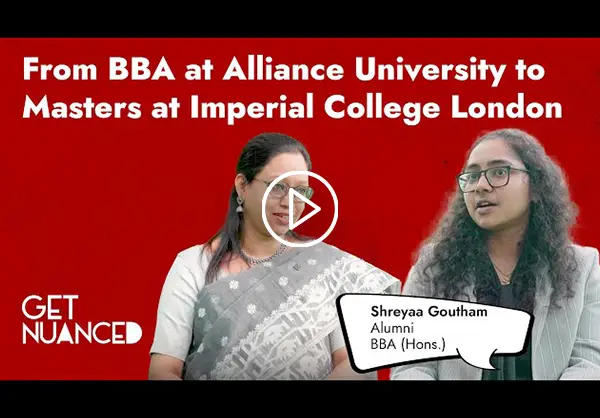
ALUMNI


Program Eligibility Criteria

Eligibility Criteria

Students must fulfill the minimum requirements of Classroom Attendance and the DSA to be eligible to take the Semester-end Examination. The minimum requirements are:

Classroom Attendance – 75%
DSA – 50% (25 marks on total of 50 marks)
Semester-end examination (SEE) – 50% (25 marks on total of 50 marks)
Students must secure a minimum of 50 percent in the Semester End Examination and 50 percent in aggregate in order to get a Pass grade.

STUDY ABROAD OPTIONS

Learn Across Borders

Experience global education through our international study opportunities designed to broaden academic perspectives and cultural understanding. These programmes enable students to study at partner universities abroad, gain international exposure, and develop the global competencies needed to succeed in an interconnected world.
Learn More

This programme allows students to spend a semester at a partner university in a foreign country to immerse themselves in a new culture and gain a fresh perspective on their discipline. In this programme, students can earn academic credits that transfer back to their home university.

The Dual Degree programme allows students to earn two degrees simultaneously, one from Alliance University and one from a partner university. The dual degree programme provides students with a unique academic experience that combines the strengths and resources of two universities. Students begin their studies at Alliance University and then transfer to a partner university abroad to complete their degree. This programme is designed for ambitious and academically driven students who want to gain a global perspective and expertise in two complementary fields of study.

FAQS

Everything You Need to Know

The CMA programme is divided into two parts, covering 12 core subjects. These include areas such as financial planning, performance analysis, cost management, risk management, and strategic financial decision-making.
BBA (Hons.) with Advantage CMA is an integrated programme that combines the BBA curriculum with the professional CMA certification. This structure enables students to work towards their degree while simultaneously completing a globally recognised professional qualification. In contrast, a regular BBA (Hons.) does not include CMA certification.
Applicants must have completed 10+2 or an equivalent examination from a recognised Board or Council with a minimum of 50 per cent in aggregate. A relaxation of five per cent, or its equivalent grade, is available for candidates from the SC or ST categories.
With the support of Alliance University’s Career Advancement and Networking (CAN) Office, graduates can explore diverse career pathways. Opportunities include roles in financial analysis, accounting, auditing, consulting, corporate finance, taxation, business strategy, and management positions across both national and global markets.
Yes. At Alliance University, students benefit from expert faculty who provide specialised CMA training. The integrated format allows students to save time by completing the CMA alongside their degree, creating a stronger and more competitive profile.
Absolutely. Graduates may pursue an MBA or other postgraduate programmes in India or abroad, while already holding the CMA qualification. Alliance graduates also enjoy preference when applying for MBA admission within the University.
Yes. CMA (USA) is internationally recognised and valued in over 100 countries. When paired with a BBA (Hons.) degree from Alliance University, it strengthens global career opportunities.
The process includes three stages: submitting the online application, appearing for the Alliance Undergraduate Management Aptitude Test (AUMAT), and attending a personal interview.
The BBA (Hons.) programme at Alliance University is four years in duration, during which students complete both the BBA curriculum and CMA training.
Yes. Alliance University offers merit-based scholarships through the Alliance University Scholastic Aptitude Test (AUSAT) and additional need-based scholarships for deserving students.
Students may choose from a range of specialisations including Finance, Marketing, Business Analytics, Human Resource Management, International Business, and FinTech, all complemented by the CMA certification.
This programme blends academic excellence with professional certification. Students gain industry exposure, mentorship from expert faculty and CMA professionals, global networking opportunities, incubation support for entrepreneurs, and dedicated placement guidance through the CAN Office.
Students engage in internships, live projects, industry-led workshops, financial case studies, simulations, access to Bloomberg terminals, and guest sessions with industry experts.
Alliance University provides structured CMA training, exam-focused sessions, personalised mentoring by certified professionals, and access to CMA study resources to ensure students are fully prepared for success.
Prospective students can connect through the official TAP platform on the Alliance University website. They can also attend open house events, information sessions, and student ambassador programmes to interact directly with peers and alumni.