Brief Overview

Bachelor of Design – BDes – Space and Interior Design

Space is a dimension that we have all integrated. Space surrounds us, protects us, and influences our thoughts, our emotions and our individual and collective behaviours. Being a space designer means having the ambition to transform collective spaces by improving the way their occupants live, work, play, exchange, and prosper.

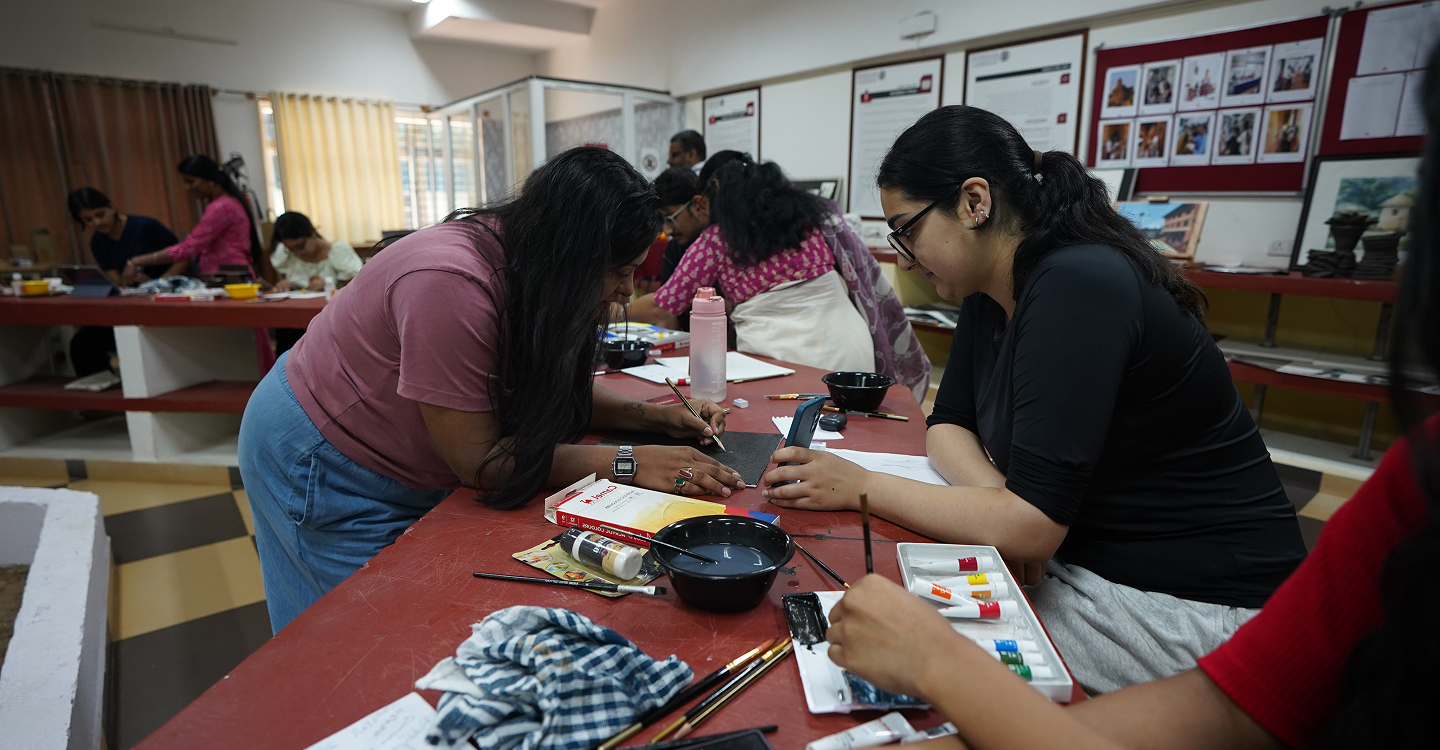
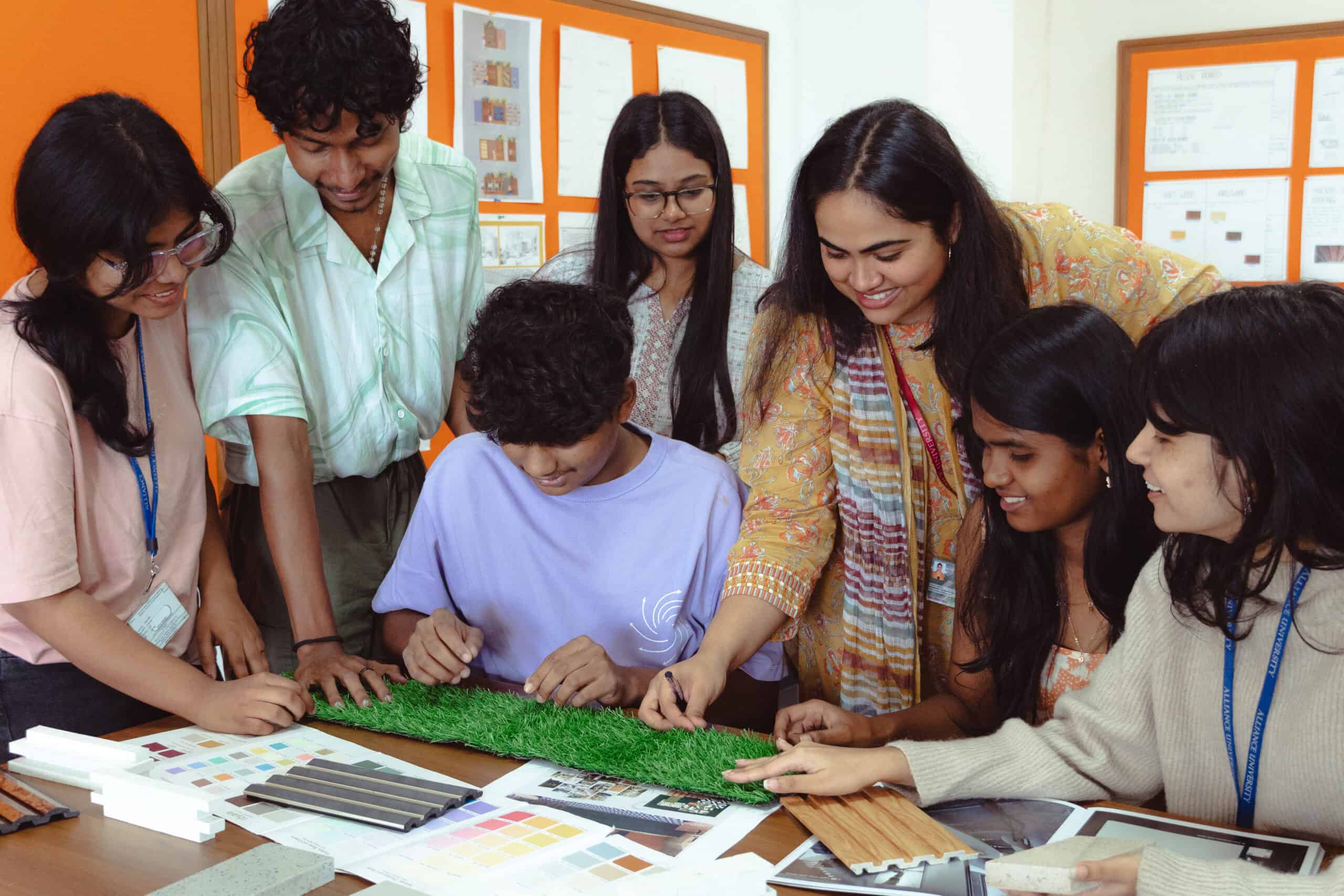
In the Interior & Space Design course, students learn how to imagine places through the sensory, physical and emotional experience that volumes, light and materials provide. This course not just encompasses all aspects of typical interior design courses and public space design; it takes them to a whole different level.

Students learn to think and design commercial, work, health, and culture spaces and environments that take into account the stakes of services, flows, identities, information, and product staging in the digital era.

Duration

Four Years / Eight Semesters

PEO (Program Educational Objectives)

PEO 1 -
The graduates will have an exposure on emerging cutting-edge technologies,
lifelong learning, adequate training and opportunities to work as teams on multidisciplinary projects with effective communication skills, individual, supportive and leadership qualities.

PEO 2 -
The graduates will be able to apply basic and contemporary science, interior construction engineering, experimentation skills to identify software/hardware problems in the industry and academia and be able to design, develop and provide practical solutions to them.

PEO 3 -
The graduates will be able to establish an understanding of professionalism, ethics, public policy and aesthetics that allows them to become good professional
Designers.

PSO (Program Specific Outcomes)

PSO 1 -
Apply the fundamental knowledge of design science of design and able to come up with logical, functional design solutions, has great knowledge of color psychology, make marketing networks and implementation of software & hardware.

PSO 2 -
Develop competence in analytical, logical & decision-making skills related to design, work on design software, multimedia and networking for efficient design according to different clients of varying complexity.

PSO 3 -
Ability to investigate dynamic technology scenarios and use computer-aided software tools for developing innovative projects in design technologies to solve real world application problems. Working with Environment and sustainability.

PSO4 -
Ethics: Understand and commit to professional ethics and responsibilities and norms of engineering practice.

PO (Program Outcomes)

PO 1:
Disciplinary/Interdisciplinary Knowledge: Apply the knowledge of design principles,
technical proficiency, creative problem-solving research aptitude, and portfolio development to address complex design challenges, foster innovation, and adapt to rapidly evolving world.

PO 2:
Complex Problem Solving: Ability to resolve complex design problems using various
methods and tools of design process, critical analysis and synthesis, creative
thinking, usercentered design, design research, prototyping and reflection.

PO 3:
Critical Thinking: Ability to independently and deeply - analyze design problems,
research, examine and evaluate concepts, provide constructive critique, consider contexts, debate contrarian views, prioritize, base decisions on evidence, to create and develop well considered design outcomes.

PO 4:
Creativity: Ability to generate new innovative ideas, experiment with new techniques, refine and creatively reframe design concepts, and problems and develop creative solutions and outcomes.

PO 5:
Communication Skills: Ability to communicate visually and aesthetically, deliver
engaging presentations, articulate clearly, participate in constructive critique,
communicate with clients and teams, and navigate cross-cultural contexts.

PO 6:
Analytical Reasoning / Thinking: Ability to break down complex problems, analyze
information, think broadly and critically, and use evidence to validate concepts and make informed decisions.

PO 7:
Research skills: Ability to conduct research effectively using various methodologies,
prioritize user-centeredness and contextual understanding, and validate design problems to create solutions informed by evidence and trends.

PO 8:
Coordinating and collaborating: Exhibit adeptness in collaborating with diverse teams, negotiating coordinated efforts, taking tasks, and efficiently working as part of a group towards a common creative goal.

PO 9:
Leadership readiness/qualities: demonstrate skills and qualities required to proactively engage, autonomously self-direct, creatively lead, take risks, seek-out knowledge and provide solutions, develop vision and direction and excel as design leaders in the industry.

PO 10:
Learning Skills: Ability to acquire new skills and knowledge adaptively and
independently throughout their careers.

PO 11:
Digital and Technological Skills: Equip graduates with proficiency in contemporary
digital tools and technologies to stay relevant and drive creativity, industry excellence and innovation.

PO 12:
Multi-cultural competence & inclusive spirit: Ability apply universal design principles. design with sensitivity, empathy, and respect, for diverse cultures and communities across various geographies.

PO 13:
Value Inculcation: Cultivating designers with a strong ethical foundation, fostering
responsible creativity, and promoting socially conscious practices within the design industry.

PO 14:
Authority, responsibility & accountability: Ability to effectively navigate authority,
embrace responsibility, and uphold accountability in their creative processes,

PO 15:
Environmental Awareness and Action: Exhibit acquired knowledge, skills, attitudes,
and values to proactively address environmental challenges, including mitigating
degradation, climate change, and pollution, implementing effective waste management, and promoting sustainable development and living.

PO 16:
Community Engagement and Service: Ability to actively engage in community
service and activities, leveraging their skills to contribute to the well-being and enhancement of society at large.

PO 17:
Empathy: Ability to empathize with and comprehend the perspectives, experiences,
and emotions of individuals or groups within the design context.


Curriculum Structure

Year 1
Semester-wise Syllabus

SEMESTER - I

Course Name Domain Category
English Academic Edge AE
French Academic Edge AE
Design software initiation Academic Edge AE
Individual and Society Academic Edge AE
Critical thinking  Academic Edge AE
Perspective - I School Core MAJOR
Graphic Design School Core MAJOR
Materials and Processes School Core MAJOR
Models and Prototypes -1 School Core  MAJOR
Creative Culture School Core MAJOR
Basic Design School Core MAJOR

SEMESTER - II

Course Name Domain Category
French - II Languages AE
English for Designers - II Languages AE
2D Intro Software AE
Creativity Methods  Soft Skills AE
Des-AI-gn and Contemporary World Software AE
Eastern and Western Societies Academic Edge AE
Stress Prevention and Psychological First Aid Academic Edge MAJOR
Perspective - II Representation Technics MAJOR
Graphique Design - II Representation Technics MAJOR
Basic Design - II Design Core MAJOR
Models and Protos Making MAJOR
Design Initiation - I Design Core MINOR
Year 2
Semester-wise Syllabus

SEMESTER - III

Course Name Domain Category
Full 2 Semester International Exchange 
OR
2D-3D interaction Design software AE
Base of animation  ??? representation technics AE
Des-AI-gner software AE
Marketing  strategy AE
Art-history+IXD hist culture AE
Reality design - design core AE
graphic design -III representation technics MAJOR
sensorial design soft skills MINOR
materials and process - (Intro to Coding, and Techno)   making MAJOR
model and proto -III (Arduino, Raspberry)  making MAJOR
Ethnography for product strategy soft skills MAJOR
Design management Project-I soft skills MINOR
story boarding  representation technics MAJOR

SEMESTER - IV

Course Name Domain Category
Full 2 Semester International Exchange 
OR
2D - assets and animation software AE
3D for XR ( asset creation and behavior)  software AE
Getting professional soft skills AE
theater/comedy soft skills AE
Research and user experience  strategy MAJOR
industry project -I Discipline core MINOR
industry short project -I Discipline core MINOR
creativity methods school core MAJOR
masterclasses -I Discipline core MAJOR
Year 3
Semester-wise Syllabus

SEMESTER - V

Course Name Domain Category
Marketing - II Strategy AE
International design competition Discipline Core AE-LBL
Internship (2 months) School Core MINOR
Long Project - II Discipline Core MINOR
Short Project -II Discipline Core MAJOR
XR - Exploration (Unity, Behavior, Techno) Software MAJOR
PORTFOLIO - Professionalisation Linkedin School Core  MINOR
Human Science Soft Skills MINOR
Research and Writing  School Core MAJOR
Masterclass - II Discipline Core MAJOR

SEMESTER - VI

Course Name Domain Category
Internship Discipline Core MAJOR
Thesis School Core MINOR
Cosplay / Board game AE - Beyond classroom AE - LBL
Year 4
Semester-wise Syllabus

SEMESTER - VII

Course Name Domain Category
Personal Project  School Core AE - LBL
END TO END APPS DEV Discipline Core   
Industry project - II Discipline Core  MAJOR
Short Industry Project - II Discipline Core  MAJOR
Interaction Design Culture Culture MAJOR
Future Tech -  Culture MAJOR
Sensorial Design - II School Core MAJOR
Systemic Approach  Soft Skills MINOR
Marketing - III Strategy MINOR
Design Strategy, Vision and Range  Strategy MINOR
Biomimicry and Circular Economy Strategy MINOR
Immersive Design Discipline Core  MAJOR

SEMESTER - VIII

Course Name Domain Category
Getting Professional - II Soft Skills AE
Personal Project / Competition AE - Beyond Classroom AE-LBL
Graduation Project  Discipline Core MAJOR
Portfolio  Discipline Core MAJOR
Cognitive Science  Soft Skills MINOR
Design Management Strategy MINOR
Minors
Semester-wise Syllabus
  Industrial Design
Project Management
Social Design and
Inclusivity
Design for
Business
SEMESTER III Sensorial Design Sensorial Design Econmomy Basics
Design Project Management - I Enthnography - 1 Finance Basics
 
SEMESTER IV Industry Project - I Social Project - 1 Business Plan and Models
Industry Short Project - I Social Short Project - I Drawing Sheet to Market Short Project - I
 
SEMESTER V Internship (2 months) Volunteering Internship (2 months) Internship (2 months)
Human Science Human Science Human Science
Portfolio - Professionalisation Social Science - I Industrial Property - I
Industry Long Project - II Design for Social Impact - I Design for Business - I
 
SEMESTER VI Thesis  Thesis  Thesis 
 
SEMESTER VII Systemic Approach Psychology International Commerce
Marketing - III Marketing - III Marketing - III
Design Strategy and Vision and Range Field Research Project Brand Identity and Social Presence
Biomimicry and Circukar Eco NGO and Vounteering Economy Costing and Marging Project - I
 
SEMESTER VIII Cognitive Science Cognitive Science Logistics
Design Management Project Management Project Management
? B. Des. INTERIOR DESIGN
NA
Creative Thinking
CAD
School of Design offers an interdisciplinary open elective that blends imagination with precision
The course introduces students to creative problem-solving methods, design thinking, and visual ideation, alongside hands-on training in Computer-Aided Design (CAD)
Learners explore how abstract ideas can be transformed into structured digital models using industry-relevant tools.
Designed for students across disciplines, the elective strengthens innovation skills, spatial thinking, and visual communication—empowering learners to confidently translate concepts into clear, professional design outcomes suitable for academic, entrepreneurial, and industry contexts.
Sed ut perspiciatis

Capstone Project

Capstone Project
The Capstone Project is a culmination of the design specialization, integrating research, critical thinking, and creative practice to address a real-world problem. It involves identifying a contextual design challenge, conducting user and stakeholder research, developing conceptual frameworks, and translating insights into innovative, socially responsive design solutions. The project demonstrates proficiency in design methodology, experimentation, visual communication, and reflective practice, while showcasing the ability to synthesize theory with practice.

Interior Design – Capstone Project
The Interior Design Capstone Project addresses spatial challenges through contextual research, programming, and design development. Students explore human behavior, materiality, lighting, and sustainability to create functional and experiential interior environments. The project showcases spatial planning, technical detailing, and the ability to translate conceptual narratives into well-resolved interior solutions.

COURSE OF INDEPENDENT STUDY

Independent Study

Lorem Ipsum is simply dummy text of the printing and typesetting industry. Lorem Ipsum has been the industry's standard dummy text ever since the 1500s, when an unknown printer took a galley of type and scrambled it

View More
INDUSTRIAL COLLABORATIONS

Industrial Collaborations

Lorem Ipsum is simply dummy text of the printing and typesetting industry. Lorem Ipsum has been the industry’s standard dummy text ever since the 1500s, when an unknown printer took a galley of type and scrambled it

ACTIVITY POINTS

Activity Points

Lorem Ipsum is simply dummy text of the printing and typesetting industry. Lorem Ipsum has been the industry\’s standard dummy text ever since the 1500s, when an unknown printer took a galley of type and scrambled it

Student

Being a B.Tech. IT student at Alliance University has been a truly engaging experience. The program combines strong fundamentals with practical exposure through projects and hands-on learning, helping me understand real-world applications of technology. With supportive faculty and a collaborative environment, I’ve been able to grow in both skill and confidence, preparing me for a career in IT.

Aashish Kumar
Batch: 2022-26

My journey as a B.Tech CSE student at Alliance University has been both challenging and rewarding.The curriculum builds strong fundamentals while emphasising hands-on learning through projects and real-world applications. With approachable faculty and opportunities to collaborate and participate in technical events, learning goes beyond the classroom. Overall, the experience is shaping me into a confident engineer and problem-solver.

Nawneet Raj
Batch: 2022-26

My experience pursuing B.Tech in Computer Science Engineering at Alliance University has been highly rewarding. The program offers a well-balanced curriculum that combines strong theoretical foundations with practical exposure.The faculty members are knowledgeable and supportive, always encouraging us to explore beyond the classroom. Through projects, hackathons, and hands-on learning, I was able to develop both technical and problem-solving skills.The campus environment and infrastructure further enhance the learning experience. Overall, this journey has played a significant role in shaping my skills and preparing me for a career in the tech industry.

Anurag Kumar Prajapati
Batch: 2023-2027

As a final-year BBA student at Alliance University, my journey has been both enriching and transformative.The program strengthened my business fundamentals while giving me hands-on exposure through projects and discussions, building my confidence in decision making. With supportive faculty, collaborative peers, and opportunities beyond academics, I’ve grown both personally and professionally.
Alliance University has shaped me into a confident, career-ready individual.

ARYAN AGARAHARI
Batch: 2023-2026

What I’ve experienced at Alliance University is not just learning business, but learning how to think like one.
Through projects, presentations, and exposure to areas like marketing and finance, I’ve built both clarity in thought and confidence in expression.
The environment constantly encourages you to take initiative, and that has made all the difference in preparing me for the professional world.

Rajnandini Malewadi
Batch: 2025-2029

As a second-year B. Design student at Alliance University, my journey so far has been about learning to think beyond just creating.
The program has helped me move from focusing only on aesthetics to understanding users, context, and the purpose behind every design decision. The learning environment encourages us to question ideas, experiment freely, and develop our own design perspective, while also building discipline in how we execute and present our work.
In these two years, I’ve grown not just in skills, but in the way I approach problems  and that’s what makes studying design at Alliance University truly meaningful.

Anannya Jain
Batch: 2024-2029

Looking back, what stands out about my time at Alliance University is not just what I’ve learned, but how I’ve learned to think.
The shift from simply studying law to questioning, interpreting, and forming my own perspective has been gradual but meaningful. Through moots, discussions, and real-world context, learning has felt active and engaging.
Today, I find myself more confident in how I analyze, articulate, and respond — and that, more than anything else, defines my journey here.

Chelana Sanklecha
Batch: 2021- 2026

Somewhere along my journey at Alliance University, BBA LL.B. became less about subjects and more about understanding connections.
The blend of business and law, through case studies and practical exposure, has helped me think more holistically and respond with clarity.
What I take forward is not just knowledge, but confidence in how I analyse and approach situations.

Shreya Pragadh
Batch: 2023-2028

Studying B.A. LL.B. at Alliance University has changed how I think, more than anything else.
It’s not just about learning law  it’s about learning how to question it. From analysing cases to participating in moots, every experience pushes you to form your own perspective rather than rely on ready-made answers.
What makes this journey meaningful is the environment. The faculty guide without restricting, and the constant exchange of ideas keeps you engaged.Somewhere along the way, you realise you’re not just studying law you’re learning how to think with clarity, argue with purpose, and respond with responsibility.

ISHITA SHUKLA
Batch: B.A.LL.B.

My MBA experience at Alliance University has been highly enriching. The program combines strong academics with practical exposure, helping me develop critical thinking and leadership skills. Supportive faculty, industry-oriented curriculum, and various learning opportunities have prepared me well for a successful career.

Palak Jain
Batch: 2025-2027

My experience pursuing BCA in Artificial Intelligence and Machine Learning at Alliance University has been both challenging and enriching. The program has helped me build a strong foundation in programming, data science, and analytical thinking. Through projects, assignments, and practical exposure, I have gained valuable skills that prepare me for real-world technology and AI applications.

Anuska Ghosh
Batch: 2024-2028

Alliance University has helped me build a strong foundation in computer science and technology. The program combines theoretical knowledge with practical learning through projects and assignments. I have gained exposure to areas like programming, data structures, machine learning, NLP, and AI related concepts so far. The collaborative environment and supportive faculty encourage continuous learning and problem-solving. Overall, it has been a valuable step in developing my technical and analytical skills.

Vishesh Gurnani
Batch: 2024-2028
Program Eligibility Criteria

Eligibility Criteria

Lorem Ipsum is simply dummy text of the printing and typesetting industry. Lorem Ipsum has been the industry\’s standard dummy text ever since the 1500s, when an unknown printer took a galley of type and scrambled it

STUDY ABROAD OPTIONS

Study Abroad

Lorem Ipsum is simply dummy text of the printing and typesetting industry. Lorem Ipsum has been the industry\’s standard dummy text ever since the 1500s, when an unknown printer took a galley of type and scrambled it

Learn More