Creative Dissertation in the fourth semester of the MA English (Creative Writing) program involves the supervised production of a book-length manuscript of creative work. This work is both genre and medium-agnostic. The best works are shortlisted for the Ismat Chughtai Best Dissertation Award that is decided by a jury comprising of internal facutly and and an external member who is usually an award-winning writer or editor.

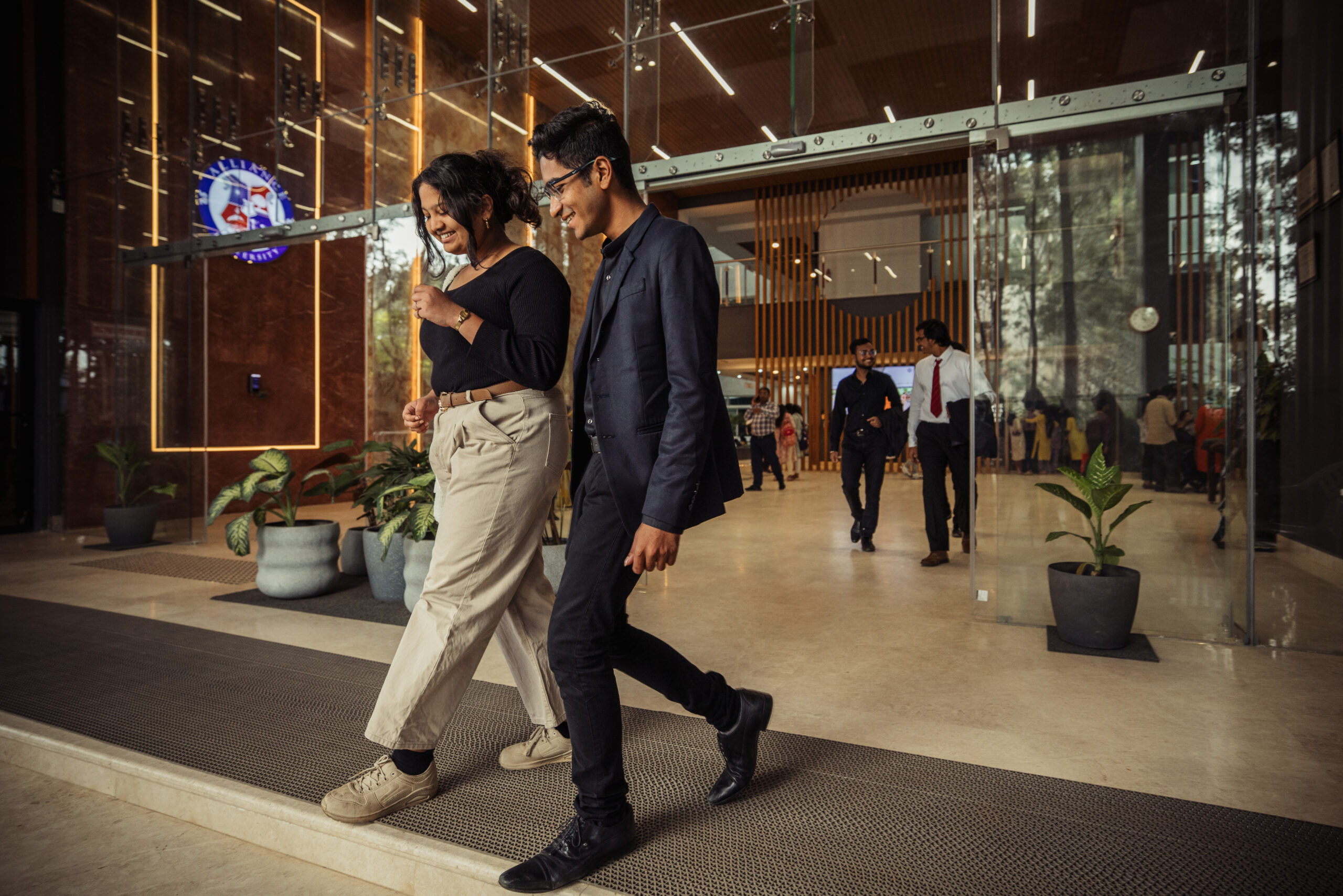
The Ph.D. (Doctor of Philosophy) program in the Faculty of Liberal Arts and Sciences is a research-intensive program that focuses on advanced scholarship in the areas of the humanities, social sciences, and sciences. Distinct from conventional discipline-bound doctoral programe, we encourage scholars to undertake pure, applied, interdisciplinary and/or multi-disciplinary research in the broad areas within the humanities, social sciences, sciences, economics, design, performing arts, and Indic studies. The program aims to equip researchers to generate original contributions to knowledge and to prepare them for careers in academic, policy, research, or leadership careers.


Why Choose
Ph. D. - School of Liberal Arts
at Alliance University?
Ph. D. - School of Liberal Arts
at Alliance University?
Lorem Ipsum is simply dummy
Global Scientific Research Synergy
Interdisciplinary research ecosystem aligned with cutting-edge global scientific priorities
Premier Instrumentation & Infrastructure
Access to premier research infrastructure, including AU-STIC instrumentation facility
Elite Scholarly Mentorship
Mentorship from globally ranked scientists and 40+ Ivy League–affiliated supervisors
Strategic Funding & Innovation Capital
Access to funded projects, Centers of Excellence, and institutional entrepreneurial research capital
Academic Experience
Advanced coursework in research methodology, laboratory and analytical techniques, ethics, academic writing, and domain-specialized research studies
Research & Innovation
Hands-on research engagement across high-impact scientific domains supported by sponsored projects, workshops, and global research forums
Mentorship & Industry Integration
Guided supervision under distinguished faculty with opportunities for interdisciplinary and international research collaboration
‹ PREV
NEXT ›
Exploring an Author, Literary Non-Fiction, Writing Workshop 1: Creative Explorations, Writing Workshop 2: Public Writing, Mechanics of Writing, Writing Poetry, Writing for Screen, Editing and Publishing, Art of Fiction:Short and Long, Graphic Narratives, Playwriting and Scriptwriting, Personal Branding and the Writerly Self, Advanced Creative Writing Research, Writing Cultural Narratives across Platforms, Corporate Brand Storytelling, Creative Dissertation
NA
Communicative English for the Workplace
Reading Popular Culture: Cinema, Comics, and Contemporary Media
PEO (Program Educational Objectives)
PEO 1: Interdisciplinary Problem Solving?
Graduates shall excel in solving complex challenges by integrating knowledge from diverse fields.?
PEO 2: Ethical and Sustainable Solutions?
Graduates shall prioritize ethics and sustainability in their problem-solving, benefiting society and the environment.?
PEO 3: Effective Communication and Collaboration?
Graduates shall communicate and collaborate effectively, enhancing their professional and research endeavours.?
PEO 4: Embrace Lifelong Learning and Global Awareness
PSO (Program Specific Outcomes)
NA
PO (Program Outcomes)
PO 1: Creativity?
Create, perform, or think in different or diverse ways about the same objects or scenarios?
PO 2: Creativity?
Think out of the box and generate solutions to complex problems to unfamiliar contexts?
PO 3: Creativity?
Adopt innovative, imaginative, lateral thinking, interpersonal skills and emotional intelligence?
PO 4: Creativity?
Confidently share views and express himself/herself?
PO 5: Communication Skills?
Construct logical arguments using correct technical language related to a field of learning, work/vocation, or an area of professional practice and convey ideas, thoughts and arguments using language that is respectful and sensitive to gender and minority group?
PO 6: Critical Thinking?
Apply analytical thought to a body of knowledge, including the analysis and evaluation of policies, and practices, as well as evidence, arguments, claims, beliefs, and reliability and relevance of evidence?
PO 7: Critical Thinking?
Identify relevant assumptions or implications; and formulate coherent arguments?
PO 8: Research-related skills?
A keen sense of observation, inquiry, and capability for asking relevant/appropriate questions?
PO 9: Critical Thinking?
The capacity to develop appropriate methodology and tools for data collection?
PO 10: Learn how to learn skills?
Work independently, identify appropriate resources required for further learning?
PO 11: Learning how to learn skills?
Inculcate a healthy attitude to be a life-long learner?
PO 12: Multicultural Competence and Inclusive Spirit?
The acquisition of knowledge of the values and beliefs of multiple cultures and a global perspective to honour diversity?
PO 13: Empathy?
The graduates should be able to demonstrate the ability to identify with or understand the perspective, experiences, or points of view of another individual or group, or to understand and identify other people's emotions.
Activity Points
Active participation and volunteering in Alliance Literary Festival is an opportunity for students to garner activity points in the Department. Additionally, they may participate in competition, conferences, and departmental clubs to score additional points
Warning: Undefined variable $word_limit in /home/mkavnn8oi4g7/public_html/alliance-university/wp-content/themes/alliance_child/academics/core-components-tab.php on line 239
Warning: Undefined variable $word_limit in /home/mkavnn8oi4g7/public_html/alliance-university/wp-content/themes/alliance_child/academics/core-components-tab.php on line 243
Warning: Undefined variable $word_limit in /home/mkavnn8oi4g7/public_html/alliance-university/wp-content/themes/alliance_child/academics/core-components-tab.php on line 244
Deprecated: array_slice(): Passing null to parameter #2 ($offset) of type int is deprecated in /home/mkavnn8oi4g7/public_html/alliance-university/wp-content/themes/alliance_child/academics/core-components-tab.php on line 244
• Applicants holding a master’s degree with a minimum of 55% marks or an equivalent grade in a point scale as prescribed by the UGC from time to time, wherever the grading system is followed.
• Applicants whose results of the final examination of a programme leading to a master’s degree are awaited may be granted provisional admission, subject to fulfilling all other admission requirements. Such candidates must submit proof of completion of the master’s degree with a minimum of 55% marks within three months of admission, failing which the admission shall stand cancelled.
• Applicants holding foreign degrees equivalent to a master’s degree with a minimum of 55% marks or an equivalent grade in a point scale as prescribed by the UGC may be admitted to the Ph.D. programme, subject to clearance by the Equivalence Committee of Alliance University.
• Applicants who have completed M.Phil. coursework with a minimum of 55% marks in aggregate or its equivalent grade in the UGC point scale, and those whose M.Phil. dissertation has been evaluated but whose viva-voce is pending, may also be admitted to the Ph.D. programme.
• Applicants possessing a degree approved as equivalent to the M.Phil. degree in India and obtained from a foreign educational institution accredited by the UGC may be admitted to the Ph.D. programme, subject to clearance by the Equivalence Committee of Alliance University.
• Admission of candidates belonging to SC/ST/OBC and other reserved categories shall be governed by the Karnataka State Rules and applicable regulations in force from time to time.
• Students from a four-year undergraduate programme (with Honors) may enroll directly in the Ph.D. programme if they have secured 75% marks or above, with a 5% relaxation for specified categories as per UGC regulations.
• Students from a four-year undergraduate programme who have secured between 55% and 75% marks may qualify after completing either a one-year master’s programme or a bridging programme of 36–40 credits. (Refer National Credit Framework (NCrF) 2024).
• For students from a three-year undergraduate programme, Ph.D. eligibility requires completion of a bridging programme of 36–40 credits along with the necessary coursework. (Refer National Credit Framework (NCrF) 2024).
Program duration
| Entry Level | Program Duration |
|---|---|
| Entry Level | 3–6 years full-time |
ACCEPTED TEST SCORES
| Particulars | Indian Nationals | Foreign Nationals |
|---|---|---|
| Registration Fee | ₹50,000 | $600 |
| program Fee (Per Annum) | ₹1,00,000 | $1,400 |
| Comprehensive Exam Fee | ₹20,000 | |
| Thesis Submission Fee | ₹30,000 | |
| Doctoral Scroll Free | ₹5,000 | |
| Convocation Fee | ₹3,000 | |
| Alumni Association Fee | ₹3,000 |
| Category | Eligibility / Scope | Grant Amount / Benefits |
|---|---|---|
| Research Fellowship | Full-time scholars | ₹35,000 per month |
| Contingency Grant | Full-time scholars | ₹25,000 per year |
| International Conference Funding | Case-by-case basis; once during the program | Up to ₹1,00,000 |
| National Workshop Funding | Scholars not receiving other funding support | ₹30,000 per year |
| Inclusion & Special Provisions | Women scholars and differently-abled scholars | Special provisions and relaxations; access to Centres of Excellence and entrepreneurial fund of ₹10 Crores |
| Policy | Conditions | Awards and funding are subject to review by the Scholarship / Research Committee; limited availability on a first-come-first-served basis |
| Steps | Description |
|---|---|
| Step 1 | Submit online application |
| Step 2 | Pay Application Fee — ₹3,000 |
| Step 3 | Alliance Research Aptitude Test (ARAT) |
| Step 4 | Personal Interview |
| Step 5 | Evaluation of research synopsis on proposed dissertation |
| Step 6 | Consideration of scholastic record, work experience, and extracurricular achievements; final selection based on overall performance |
Living Spaces That Inspire Belonging
EXPLORE OUR HOSTELS
Comfort, safety, and community form the foundation of campus living. Our residential halls are thoughtfully designed to create a sense of belonging—offering a welcoming environment where students can study, unwind, and build lifelong friendships.

Separate hostels
for boys and girls
Student-friendly
common areas
Spacious rooms
(single, double, or triple occupancy)
Dedicated wardens
and support teams
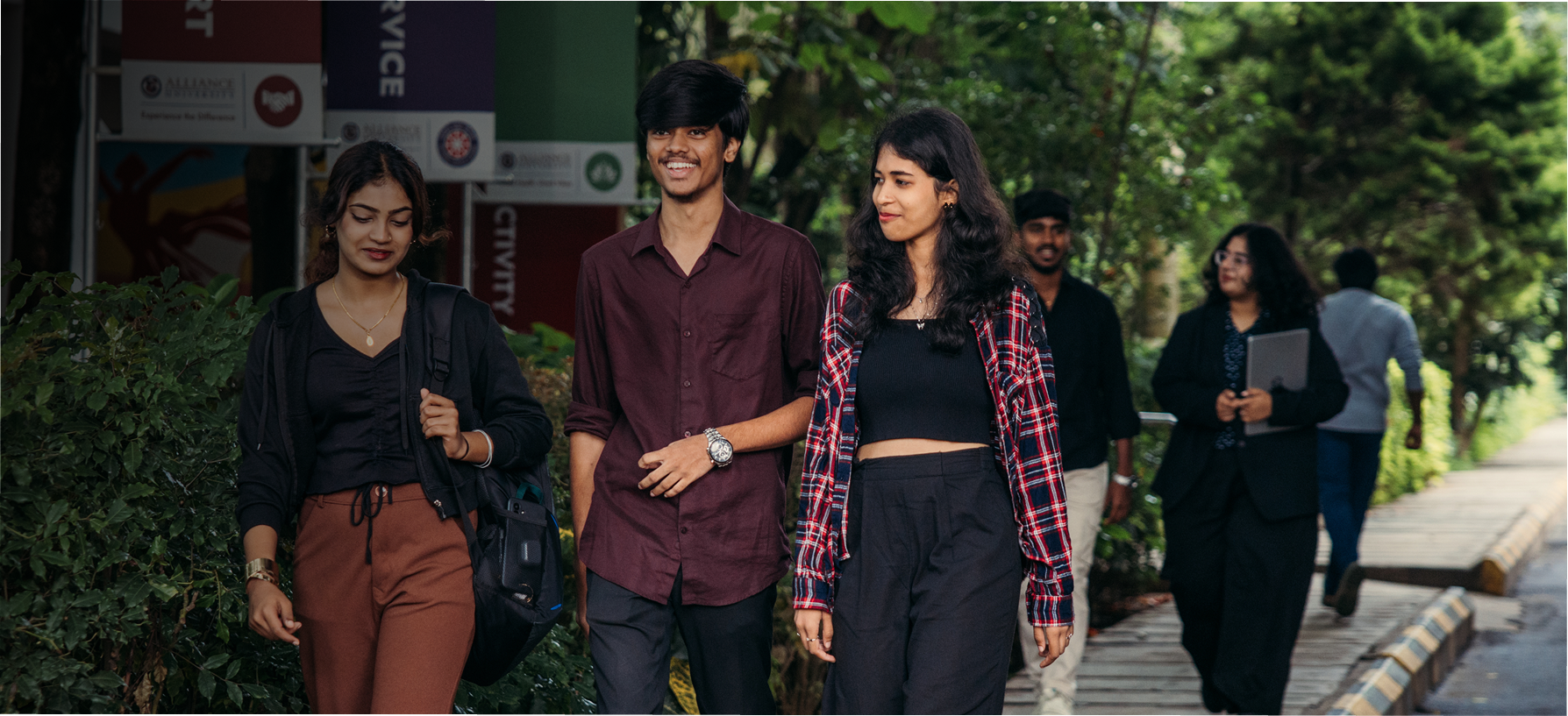
Real Stories, Real Impact
STUDENT
A remarkable opportunity for aspiring researchers seeking to broaden their perspectives and explore innovative research ideas actively. The program’s emphasis on classroom teaching, combined with the university’s commitment to excellence in research, creates an inspiring academic environment that challenges students to think critically and creatively. As a Research Scholar at Alliance University, I am grateful for the unique and unparalleled academic experience that has empowered me as a researcher and enriched my understanding of my field of study.
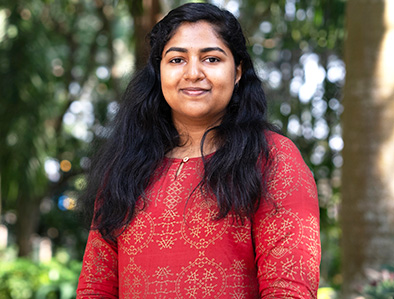
Ashly Ann Binu
Branch: Ph.D. from School of Liberal Arts - English
Batch: 2023
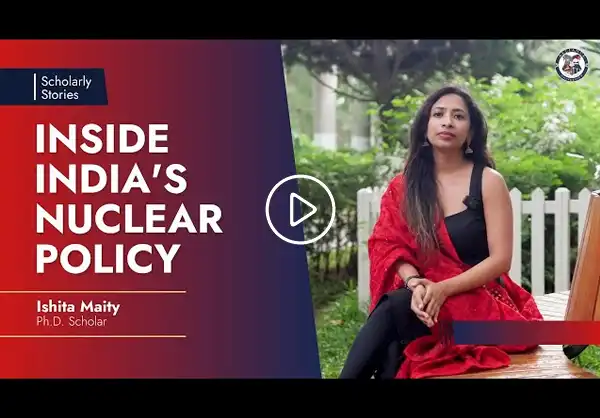
Alliance School of Liberal Arts enabled my trans-disciplinary PhD research on nuclear policy strategies of India with an analytical approach. The program provided numerous conference opportunities, helpful faculties, good research infrastructure, and a great research environment, making it my preferred choice.

Ishitha Maity
Branch: Ph.D. from School of Liberal Arts - Political Science
Batch: 2023
Alliance University is a magical place that captures your attention with its stunning architecture and lush greenery. As a Ph.D. student in the School of Liberal Arts, I was welcomed by a supportive faculty who encouraged interdisciplinary research and provided ample opportunities to interact with national and international scholars. Participation in conferences and literary festivals kept me engaged and informed about the knowledge industry. Teaching experience provided valuable insights into the thought process of future generations.
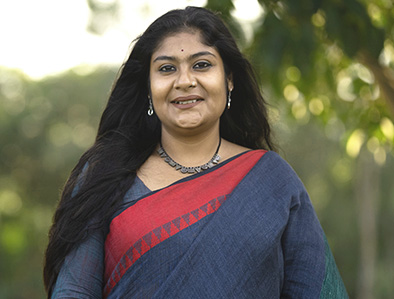
Tias Maity
Branch: Ph.D. from School of Liberal Arts - Philosophy
Batch: 2023
At Alliance University, the Ph.D. program is tailored to meet each student’s specific needs. The experienced and knowledgeable faculty is always available to help clear up any doubts and recommend helpful resources. The library and administrative staff are also very helpful. I’m grateful for the opportunity to gain teaching experience, which has been very valuable.
Snata Bagchi
Branch: Ph.D. from School of Liberal Arts - English
Batch: 2023
The School of Liberal Arts of Alliance University is redefining the concept of higher education in India. Breaking away from the usual norms, the School of Liberal Arts enhances the horizon of knowledge and prepares students for tomorrow’s reality. The Ph.D. program conducted here provides significant opportunities for scholars to explore. With state-of-the-art infrastructure, a well-facilitated library and digital archives, and access to several journals of global significance, conducting research becomes all too easy for scholars. The School of Liberal Arts also consists of well-reputed faculty members who are extremely supportive and provides us with significant guidance. Alliance University does not confine the students’ scholastic minds as scholars can choose their research supervisors and their concerned research disciplines. The program also allows us to teach and guide undergraduate students, thereby providing us with practical classroom experiences that will benefit those who desire to be in academia after the completion of the Ph.D. course.
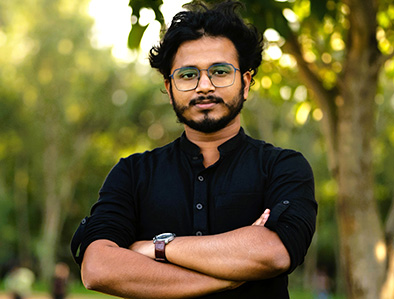
Francis Banerjee
Branch: Ph.D. from School of Liberal Arts
Batch: 2023
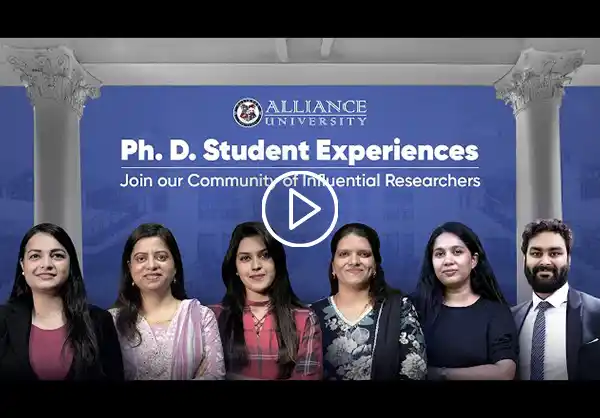
Everything You Need to Know
What is the scope of a Ph. D. in Liberal Arts?
The scope of Liberal Arts is broad, spanning careers across academia, policy, industry, and research, with a focus on societal development and addressing global challenges.
How long does it take to get a Ph. D. in Liberal Arts?
A Ph. D. generally takes three to six years, depending on research complexity and the timely completion of the thesis.
Can you get a Ph. D. in Liberal Arts?
Yes. Alliance University offers a Ph. D. in Liberal Arts.
What are the subjects in Ph. D. in Liberal Arts?
Specializations include Cultural Studies, English, Hindi, Kannada, Media Studies, Political Science, Psychology, Philosophy, and Sociology.
What kind of research methodology training is provided in this program?
The program includes intensive coursework before the research phase, including Research Methodology and Research & Publication Ethics.
Can professionals from industry or non-academic backgrounds apply for the Ph. D.?
Yes, the program welcomes professionals and candidates from diverse backgrounds, promoting interdisciplinary exploration.
How does Alliance University support scholars with resources, libraries, and mentorship?
Scholars have access to digital libraries such as Scopus and EBSCO, along with mentorship from experienced faculty and research support resources.
Are scholarships or fellowships available for Ph. D. candidates?
Yes, full-time scholars receive a monthly fellowship of INR 35,000 and an annual contingency grant of INR 25,000.
What research areas can I explore in Alliance University’s Ph. D. in Liberal Arts?
Research areas include Cultural Studies, English, Media Studies, Political Science, Psychology, Sociology, and interdisciplinary themes such as climate change and social development.
How does Alliance University’s Ph. D. in Liberal Arts integrate emerging themes like digital humanities or social impact?
The program emphasizes interdisciplinary research focused on global challenges such as climate change, social inequality, and technological ethics, aiming to develop future thought leaders.
What is the Ph.D. in Liberal Arts program?
A research-intensive doctoral program enabling scholars to explore human experience, culture, behavior, communication, and society through advanced scholarly inquiry.
What research areas are available?
Cultural Studies, English, Hindi, Kannada, Media Studies, Political Science, Psychology, and Sociology.
What is the eligibility requirement?
Master’s degree with ?55% marks; additional pathways available under UGC and NCrF 2024 norms.
What is the program duration?
Typically 3–6 years depending on research progress.
What financial assistance is available?
Fellowships, contingency grants, and travel support for academic engagement.
How are candidates selected?
Through application review, research assessment, personal interview, and proposal evaluation.
What facilities are available?
AU-STIC research facility, academic resource centers, and global research databases.
Can international degree holders apply?
Yes, subject to equivalence clearance.
Are category-based relaxations available?
Yes, in accordance with statutory guidelines.
Can scholars transfer from other institutions?
Yes, upon approval.
What coursework is included?
Research Methodology, Research & Publication Ethics, Advanced Liberal Arts Scholarship, Academic Writing, and Research Practicum.
Course Framework
| Course Type | Course Name | Credits |
|---|---|---|
| University Core | Research and Publication Ethics | 2 |
| University Core | Learning and Development | 1 |
| University Core | Academic Writing | 1 |
| Department Core | Research Methodology | 4 |
| Department Elective | Directed Course | 4 |
| Total Credits | 12 |
Program Outcomes
• Research Competence & Knowledge Creation – Demonstrate proficiency in applying advanced research methodologies, analytical techniques, and experimental designs to produce high-quality research outcomes.
• Research Ethics & Integrity – Uphold ethical research practices by ensuring compliance with academic integrity, plagiarism standards, and responsible data management.
• Effective Communication & Knowledge Dissemination – Demonstrate excellence in academic writing, presentations, publications, and scholarly discourse.
• Societal Impact – Align research with societal needs and the Sustainable Development Goals (SDGs), contributing to policy development, industry innovation, and community advancement.
• Lifelong Learning & Continuous Professional Development – Engage in continuous learning and professional growth by keeping abreast of emerging trends, theories, and best practices in the field.
Research Highlights
• Structured Coursework – A semester-long coursework with a special focus on Research Methodology and Academic Writing, enabling scholars to develop a concrete research proposal by the end of the coursework.
• Research Values and Ethics – University Core courses equip scholars with the foundational values, ethics, and principles essential for responsible and impactful research.
• Customized Directed Courses – Directed courses are specifically designed to cater to each scholar’s individual research interests and areas of specialization.
• Early Supervisor Allocation – Supervisors and co-supervisors are allocated within the first 15 days of admission, ensuring guided research from the beginning of the programme.
• Research Advisory Committee – Each scholar is supported by a Research Advisory Committee comprising both internal and external experts who provide guidance in specialized research areas.
• Global Mentorship Opportunities – Co-supervisors and Research Advisory Committee members may be drawn from academia and industry, including international experts.
• Research Fellowship Support – Monthly fellowship of Rs.35,000 for Junior Research Fellows (JRF) and Rs.42,000 for Senior Research Fellows (SRF) from the third year onwards.
• Research and Conference Funding – Annual contingency grant of Rs.25,000 and conference/workshop/seminar funding of Rs.30,000 per year, extendable up to Rs.1,00,000.
• Research Excellence Awards – Recognition and awards for scholars with outstanding research publications.
• Rigorous Doctoral Evaluation – Ph.D. degree awarded upon successful completion of coursework, qualifying examination, and original research work evaluated by the competent authority.
• Research Scholar Mobility – Facility for transfer of research scholars between Alliance University and other universities or research institutions.
• Inclusive Research Environment – Special provisions and relaxations for women research scholars and specially-abled persons.
• Extensive Research Resources – Access to leading research databases including IEEE, Scopus, SciVal, EBSCO, Derwent, The Case Centre, and Harvard Case Studies.
Areas of Research
Departments Offering Doctoral Research
School of Liberal Arts and Humanities
- English
- Kannada
- Hindi
- Psychology
- Sociology
- Political Science
- Film and Media Studies
- Philosophy
- Cultural Studies
School of Sciences
- Pure and Applied Mathematics
- Physics
- Chemistry
School of Economics
- Economics
School of Transdisciplinary Design
- Transdisciplinary Design
Interdisciplinary Areas of Research
Transdisciplinary Studies
An integrative research approach that combines knowledge, methodologies, and perspectives from multiple disciplines to address complex societal challenges through sustainability- and development-oriented frameworks.
Sub-Areas under Transdisciplinary Studies
• Consumer Culture and Material Culture Studies – Examines lifestyle, consumption patterns, buying behavior, and the social and symbolic meanings of material objects, while addressing climate-responsive design, civilizational aesthetics, semiotics, and sustainability.
• Critical Sustainability Studies – Focuses on the social, political, economic, and ethical dimensions of sustainability, emphasizing ecological integrity, future-oriented thinking, responsible innovation, and sustainable development.
• Gender Studies – Investigates gender identity, gender expression, and the intersections of gender with social, cultural, political, and psychological dimensions of human experience.
• Ethnic and Marginalized Community Studies – Explores issues related to marginalization, social exclusion, identity, equity, representation, and the lived experiences of underrepresented communities.
• Critical Communication, Media and Advertisement Studies – Examines the influence of media, communication systems, and advertising on society, culture, identity formation, and power structures through critical analysis.
• Indian Ethnocentric Design – Focuses on integrating Indian Knowledge Systems, value systems, ecological perspectives, and modern scientific approaches to create holistic and contextually relevant design frameworks.
• Urban Studies – An interdisciplinary field that studies cities, urbanization, societal structures, culture, economics, design, geography, and planning to better understand urban transformation and development.
• Cultural Studies – Investigates culture as embedded within everyday life, media, language, institutions, and power structures, examining themes such as representation, identity, class, gender, colonialism, capitalism, resistance, and social change.