Admissions Open 2026-2027. Apply Now Admissions Open 2026-2027. Apply Now Admissions Open 2026-2027. Apply Now Admissions Open 2026-2027. Apply Now Admissions Open 2026-2027. Apply Now Admissions Open 2026-2027. Apply Now

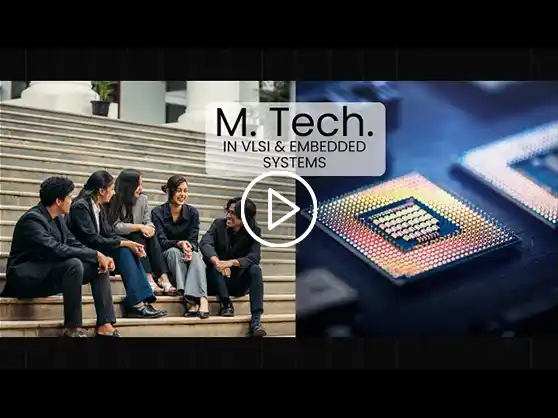
The programme offers an industry-aligned curriculum engineered to meet the advanced demands by Integrating front-end RTL design, back-end physical design, and embedded system development, focusing on building expertise in microelectronic circuit design, ASIC / FPGA implementation and mixed signal verification.

With application-driven modules tailored for high-growth sectors such as automotive electronics, industrial automation, and medical instrumentation, the curriculum provides exposure to industry-standard EDA tools, TCAD tools and embedded platforms. Leveraging a strong blend of theoretical rigor and hands-on lab experience, the program aims to develop industry-ready engineers with competencies that are highly valued by VLSI Design and Embedded product firms.

Duration

Two Years / Four Semesters

Why Choose
M. Tech. in VLSI and Embedded Systems
at Alliance University?
Lorem Ipsum is simply dummy
Strategic Industrial Synergy
Strategic Industry Collaborations with leading Semiconductor Pvt. Ltd., ensuring that the curriculum remains aligned with current industry needs and trends.
Global Academic Mobility
Global exposure through Summer Exchange Programme.
Transnational Research Partnership
International collaboration with Youngstown State University, Ohio, USA.
Industry-Standard Tool Proficiency
Practical application with leading tools such as mentor graphics and cadence.
Accelerated Doctoral Pathway
Seamless transition to Ph. D. programme.
Integrated Professional Practicum
Industry-integrated internships.

Course Category
Applied Probability and Statistics PC
Research Methodology and IPR PC
Advanced Data Structures and Algorithms PC
Distributed Databases PC
Bayesian Machine Learning PE
Fundamentals of Edge Computing PE
High Performance Scientific Computing PE
IoT Sensors & Microcontrollers PE

Course Category
Multicore Computing PC
Network Technologies PC
Reinforcement Learning PE
Edge Security PE
OpenMP PE
IoT Data Analytics PE
Elective - III (Industrial Certification) PC
Term Paper - I PC

Course Category
Generative AI PC
Elective - IV (Industrial Certification - II) PC
Ensembling with TensorFlow PE
TinyML PE
OpenCL PE
Industrial IoT PE
Term Paper - II PC

Course Category
Dissertation PC

Course Categories:

PC : Program Core || PE : Program Elective

The Capstone Project represents a key integrative component of the M.Tech Artificial Intelligence & Data Science (AIDS) program, providing students with the opportunity to apply advanced knowledge and technical skills to solve complex, real-world problems. Typically undertaken in the later stages of the program, this experience enables students to work individually or in small teams, synthesizing concepts from core and elective courses into innovative and impactful solutions.

The Capstone Project is designed to foster:

  • Advanced analytical thinking and problem-solving

  • Innovation, design thinking, and research-driven development

  • Project planning, execution, and professional practices

  • Application of AI and data science techniques to real-world challenges


Students are required to develop robust models, scalable systems, or data-driven solutions using real-world datasets and contemporary tools. A mandatory outcome of the Capstone Project is the publication of research work in a recognized conference or peer-reviewed journal, ensuring that students gain experience in scholarly writing, validation, and dissemination of their work.

Strong emphasis is placed on originality, technical depth, and research contribution. The outcomes may include prototypes, high-quality technical reports, and publishable research aligned with industry and societal needs.

Serving as a critical, portfolio-defining experience, the Capstone Project significantly enhances students’ preparedness for advanced roles in industry, research, and academia, positioning them as competent professionals capable of contributing to innovation and knowledge creation in intelligent systems and data science.
Program Electives

The Program Electives component of the MTech – VLSI and Embedded Systems curriculum provides students with the flexibility to explore advanced and application-oriented domains within AI and data science. It enables learners to deepen their expertise in specific areas of interest while aligning their academic pathway with career goals and emerging industry trends.

The Program Electives emphasize:

  • Domain-specific knowledge and specialization within AI and data science

  • Application of advanced analytical and computational techniques

  • Design and deployment of intelligent, data-driven solutions

  • Interdisciplinary learning across emerging technological areas

  • Industry relevance through practical case studies and project-based learning

By offering a diverse set of elective choices, this component empowers students to tailor their learning experience, enhance technical depth, and prepare for specialized roles in research, industry, and innovation-driven environments.

Program Elective List:

  • Predictive Analytics

  • Time Series Analysis and Forecasting

  • System Design for Robots and Drones

  • Human–Machine Interaction and Interface

  • Financial Data Analytics

  • Healthcare Data Analytics

  • Robotics System Integration

  • Business Intelligence and Analytics

  • Applied Social Network Analysis

PEO (Program Educational Objectives)

PEO 1.

To equip graduates with a strong foundation in computing principles and emerging technologies, enabling them to design, develop, and innovate scalable and intelligent solutions

PEO 2.

To develop graduates with leadership, problem-solving, and entrepreneurial skills to drive technological advancements and contribute to industry, research, and startup ecosystems

PEO 3.

To instill ethical responsibility, sustainability, and a commitment to using technology for addressing global and societal challenges.

PEO 4.

To develop AI-driven problem solvers who can extract insights from vast datasets and build predictive models

PSO (Program Specific Outcomes)

PSO1 :

To design, implement, and optimize intelligent, secure, and scalable computing solutions by integrating emerging technologies .

PSO2 :

To apply computational thinking and interdisciplinary knowledge to develop innovative, ethical, and sustainable technology solutions that address real-world societal and industrial challenges

PSO3 :

To design and implement AI and data analytics solutions that drive decision-making and innovation across industries

PO (Program Outcomes)

PO1. Research and Problem Solving:

An ability to independently carry out research /investigation and development work to solve practical problems

PO2. Technical Communication:

An ability to write and present a substantial technical report/document

PO3. Comprehensive Disciplinary Knowledge:

Students should be able to demonstrate a degree of mastery over the area as per the specialization of the program. The mastery should be at a level higher than the requirements in the appropriate bachelor program

PO4. Design/Development of Solutions:

Graduates can design and develop AI-powered solutions for real-world problems, considering constraints and ethical implications.

PO5. Modern Tool Usage:

Graduates are proficient in using modern AI and data science tools and libraries to handle large datasets and complex models, making them suitable for real-world applications.

PO6. Life Long Learning:

Graduates possess the ability to learn new things and adapt to the rapidly changing field of AI and data science

Program Core

The Program Core forms the foundation of the MTech – VLSI and Embedded Systems curriculum, focusing on developing advanced analytical, computational, and research-oriented expertise in intelligent systems and data-driven technologies. It is carefully designed to enable students to model, analyze, and solve complex real-world problems using cutting-edge AI and data science methodologies aligned with current industry and research demands.

This component includes key subjects such as Applied Probability and Statistics, High Performance Computing for Big Data, Cognitive AI, Decision Support Systems, Virtual Reality, IoT Sustainable Solutions, and Research Methodology and IPR, among others. These courses are structured to provide a strong integration of mathematical foundations, algorithmic thinking, system-level understanding, and applied intelligence.

The Program Core emphasizes:

  • Advanced problem-solving and analytical thinking

  • Design and development of intelligent and scalable systems

  • Data-driven decision-making and predictive modeling

  • Integration of emerging technologies and interdisciplinary approaches

  • Research, innovation, and technical communication skills

With a balanced focus on theoretical depth, practical implementation, and research orientation, the Program Core prepares students for advanced roles in AI and data science, including research, industry applications, and technology innovation.

The Dissertation and Research Component is a central element of the M.Tech Artificial Intelligence & Data Science (AIDS) curriculum, providing students with a comprehensive research experience that emphasizes innovation, analytical rigor, and real-world problem-solving. This component enables students to undertake in-depth, research-driven work addressing complex challenges aligned with industry needs and societal impact.

Students actively engage in advanced research activities including problem formulation, extensive literature review, methodology design, data collection and analysis, model development, experimentation, evaluation, and validation. The work typically focuses on areas such as artificial intelligence, machine learning, big data analytics, intelligent systems, and emerging technologies, leading to the development of scalable solutions and novel contributions.

The research process is guided by faculty mentors and, where applicable, industry experts, with access to advanced computing infrastructure, datasets, cloud platforms, and specialized laboratories. Students are expected to produce high-quality outcomes including a detailed dissertation, technical artifacts, and mandatory publication of their research in reputed conferences or peer-reviewed journals.

The Dissertation and Research Component emphasizes:
a) Advanced research methodology and analytical problem-solving
b) Design and development of innovative AI and data-driven solutions
c) Experimental evaluation, validation, and optimization of models
d) Technical writing, scholarly communication, and dissemination of research
e) Outcomes such as publications, prototypes, patents, and impactful solutions

This structured research experience ensures that graduates develop strong research aptitude, technical depth, and innovation capabilities, preparing them for doctoral studies, R&D roles, and leadership positions in academia, industry, and technology-driven enterprises.

The Capstone Project is designed to foster:

  • Advanced analytical thinking and problem-solving
  • Innovation, design thinking, and research-driven development
  • Project planning, execution, and professional practices
  • Application of AI and data science techniques to real-world challenges

Students are required to:

  • Develop robust models, scalable systems, or data-driven solutions using real-world datasets and contemporary tools
  • Publish research work in a recognized conference or peer-reviewed journal
  • Gain experience in scholarly writing, validation, and dissemination of research

The Capstone Project emphasizes:

  • Originality, technical depth, and research contribution
  • Development of prototypes and high-quality technical reports
  • Creation of publishable research aligned with industry and societal needs

Outcomes of the Capstone Project include:

  • Enhanced preparedness for advanced roles in industry, research, and academia
  • Strong portfolio-building experience through innovation-driven projects
  • Capability to contribute to intelligent systems and data science domains
  • Readiness for knowledge creation, research, and technology innovation

The Course of Independent Study (CIS) is a distinctive 3-credit academic pathway that offers students a valuable opportunity to engage in research-oriented learning through a faculty-mentored project in place of one course within their curriculum. Designed to nurture intellectual curiosity, innovation, and critical thinking, the course enables students to immerse themselves in hands-on research through laboratories, field-based work, or Centres of Excellence. Under close faculty guidance, students identify research problems, pursue structured inquiry, and develop meaningful academic outcomes. Credits are earned through consistent progress, active participation in review milestones, successful completion of the project, and the preparation and submission of a research paper to a Scopus-indexed journal, conference, or other approved scholarly platform—positioning students for early exposure to high-quality research and scholarly contribution.

The Industry Internship Programme is a vital component of the M.Tech Artificial Intelligence & Data Science (AIDS) curriculum, designed to provide students with advanced industry exposure and hands-on experience in solving real-world, data-driven problems. Integrated within the academic framework, the internship enables students to apply advanced AI, machine learning, and data analytics concepts in professional environments, effectively bridging the gap between academic research and industry practices.

Typically undertaken during the later phase of the program, the internship offers opportunities to work with leading technology companies, startups, research labs, and innovation centers across domains such as artificial intelligence, data science, big data engineering, cloud computing, cybersecurity, intelligent systems, and automation. Students engage in live projects, research-driven development, and collaborative problem-solving, gaining insights into modern tools, frameworks, and deployment practices.

The programme emphasizes:

  • Application of advanced AI and data science techniques to real-world challenges
  • Development of professional, communication, and interdisciplinary teamwork skills
  • Exposure to industry-standard tools, platforms, and deployment environments
  • Hands-on experience with large-scale data systems and intelligent applications
  • Strengthening research aptitude and innovation through practical engagement

Guided by both academic mentors and industry supervisors, students are evaluated based on their technical contributions, problem-solving ability, innovation, and professional conduct. The internship may also lead to research outcomes, technical reports, or contributions aligned with conference or journal publications, reinforcing the research-oriented nature of the program.

The Industry Internship Programme plays a crucial role in preparing students for advanced careers in AI and data science, enabling them to transition effectively into roles in industry, research organizations, and innovation-driven enterprises as highly skilled and industry-ready professionals.

STUDY ABROAD OPTIONS

International Mobility

Experience global education through our international study opportunities designed to broaden academic perspectives and cultural understanding. These programmes enable students to study at partner universities abroad, gain international exposure, and develop the global competencies needed to succeed in an interconnected world.

Learn More

An opportunity that lets students begin their degree at Alliance University (1 or 2 years) and then transfer to a foreign university to complete and earn their degree internationally.

Explore the World: Study a semester abroad, earn transferable credits, and gain global insights while experiencing a new culture and expanding your skills.

Learn More

Alliance University welcomes students from across the world to study, collaborate, and thrive in a truly global learning ecosystem. We combine academic rigour with industry exposure, modern infrastructure with personalised support, and global perspectives with Indian values.

Learn More

Recognising Effort, Celebrating Success

Category Eligibility Criteria
General B. Tech. (Regular) – 10+2 with minimum 50% marks in Physics & Mathematics + one of Chemistry / Biotechnology / Biology / Technical Vocational Subject. Valid score in JEE (Main) / JEE (Advanced) / Karnataka CET / COMED-K / AUEET / or other recognized State-Level engineering examinations.
B. Tech. (Lateral) – Diploma (≥50%) in relevant branch or B.Sc. (≥50%) with Mathematics in 10+2.
Reserved Categories 5% relaxation for SC / ST candidates
Program duration
Entry Level Program Duration
Regular Level Four Years / Eight Semesters
Lateral Level Three Years / Six Semesters

ACCEPTED TEST SCORES
AUSAT
AUSAT
AUSAT
AUSAT

Particulars Indian Nationals Foreign Nationals
Registration Fee (as per admission cycle) ₹25,000 US$500
1st Installment ₹1,75,000 US$2,250
2nd Installment ₹2,00,000 US$2,750
Total program Fee ₹4,00,000 US$5,500


Category Eligibility Scholarship
SC / ST 60% & above (X & XII) + 70% & above National-Level Entrance Test 20% Tuition Fee Waiver
Differently-Abled 50% & above (X & XII) 50% Tuition Fee Waiver
Defence & Paramilitary 60% & above (X & XII) + 70% & above Entrance Test 15% Tuition Fee Waiver
International-Level Sportsperson 50% & above (X & XII) 100% Tuition Fee Waiver
National-Level Sportsperson 50% & above (X & XII) 50% Tuition Fee Waiver
Domicile Students 60% & above (X & XII) + 70% & above Entrance Test 5% Tuition Fee Waiver
Policy Conditions Scholarships subject to approval and documentation. Limited seats.
Learn more


Steps Description
Step 1 Submit Online Application
Step 2 Pay Application Fee — ₹1000 (US$50 for foreign nationals)
Step 3 Appear for Alliance Entrance Assessment
Step 4 Oral Extempore Presentation
Step 5 Personal Interview Assessment
Step 6 Selection based on overall profile & performance
Start your application now

Living Spaces That Inspire Belonging

EXPLORE OUR HOSTELS

Comfort, safety, and community form the foundation of campus living. Our residential halls are thoughtfully designed to create a sense of belonging—offering a welcoming environment where students can study, unwind, and build lifelong friendships.

Separate hostels
for boys and girls

Student-friendly
common areas

Spacious rooms
(single, double, or triple occupancy)

Dedicated wardens
and support teams

residential-image-update

Real Stories, Real Impact

STUDENT

Everything You Need to Know

What is the scope of M. Tech. in VLSI and Embedded Systems?
The M. Tech. in VLSI and Embedded Systems offers excellent career scope with strong demand across semiconductor, telecommunications, automotive, aerospace, and consumer electronics industries. Graduates can pursue roles such as VLSI Design Engineer, ASIC Verification Engineer, Physical Design Engineer, and Embedded Systems Developer, contributing to advanced technologies in AI, IoT, autonomous systems, and chip design.
What is the duration and structure of the M. Tech. in VLSI and Embedded Systems programme?
The programme is a two-year postgraduate degree structured across four semesters. It combines theoretical learning, laboratory sessions, industry-integrated internships, and project-based training using advanced tools and technologies relevant to VLSI and embedded systems.
What is the M. Tech. in VLSI and Embedded Systems programme about?
The programme is designed to develop advanced expertise in semiconductor technologies, embedded systems, and chip design. It covers front-end and back-end VLSI design, embedded hardware and software integration, and nanoscale device development, preparing students for both industry and research careers.
What subjects are taught in the M. Tech. in VLSI and Embedded Systems programme?
The curriculum includes subjects such as High-Speed VLSI Design, ASIC Design, Embedded Linux System Design and Development, Embedded Systems for Automotive Applications, Advanced Microprocessors and Microcontrollers, RF and MMC Circuits, Digital System Testing and Testable Design, and Hardware-Software Co-Design.
Is the programme suitable for pursuing a Ph. D. or research career?
Yes. The programme provides a strong research-oriented foundation through advanced coursework, laboratory experience, and industry-integrated projects, making it suitable for students interested in pursuing doctoral studies or research careers.
Who is eligible to apply for the M. Tech. in VLSI and Embedded Systems at Alliance University?
Applicants must hold a B.E. / B. Tech. degree in Electronics and Communication Engineering, Electronics and Telecommunications, Electronics Engineering, or Electronics and Computer Science with a minimum of 50% marks or equivalent CGPA. A relaxation of 5% may be applicable for SC/ST candidates.
What core subjects, such as CMOS design or IoT programming, are included in the curriculum?
The programme includes core subjects such as Analogue CMOS IC Design, embedded system programming, advanced microprocessors, digital design methodologies, and hardware-software integration, providing strong foundations in both VLSI and embedded technologies.
Does Alliance University’s M. Tech. in VLSI and Embedded Systems offer internships or projects with semiconductor firms?
Yes. The programme includes industry collaborations and internship opportunities through partnerships with organisations such as Tessolve Semiconductor Pvt. Ltd., allowing students to work on industry-relevant projects and gain practical exposure to semiconductor technologies.
Is the programme suitable for careers in 5G chip design or autonomous systems?
Yes. The curriculum covers advanced topics relevant to 5G communication systems, embedded intelligence, semiconductor design, and autonomous technologies, making graduates well-prepared for emerging careers in these domains.
What advanced tools are used in the programme?
Students receive practical training using industry-standard tools such as Mentor Graphics and Cadence for chip design, simulation, verification, and embedded systems development.
What entrance exams are required for admission?
Admission to the programme is based on an online aptitude test followed by a personal interview conducted by Alliance University.
Are scholarships or financial aid available for students?
Yes. Alliance University offers merit-based scholarships, category-based scholarships, and need-based financial assistance for eligible students pursuing the M. Tech. in VLSI and Embedded Systems programme.
What makes Alliance University’s M. Tech. in VLSI and Embedded Systems a leading choice in India?
The programme stands out due to its strong industry collaborations, advanced Centres of Excellence, industry-integrated internships, expert faculty, practical learning approach, and exposure to global technologies, ensuring students are prepared for both research and high-impact industry careers.
How does Alliance University’s placement cell support students?
The Career Advancement and Networking (CAN) Department supports students through career counselling, placement training, workshops, guest lectures, live projects, certification programmes, and industry exposure activities, helping students secure opportunities with leading organisations.
What job roles are available after completing the M. Tech. in VLSI and Embedded Systems programme?
Graduates can pursue roles such as Hardware Design Engineer, Verification Engineer, Validation Engineer, ASIC Layout Engineer, R&D Engineer, Technical Lead, Device Engineer, and Systems Engineer across semiconductor and embedded technology industries.
What is M.Tech. in VLSI and Embedded Systems? +

A specialised postgraduate engineering program focused on semiconductor device design, IC design workflows, ASIC/FPGA development, and embedded product engineering.

What industries hire VLSI & Embedded graduates? +

Semiconductor design, electronics, automotive systems, industrial automation, aerospace, telecommunications, consumer electronics, and medical devices.

What roles can graduates pursue? +

VLSI Design Engineer, RTL Engineer, Verification Engineer, ASIC Engineer, FPGA Engineer, Embedded Systems Engineer, Hardware-Software Co-Design Engineer.

Is the curriculum industry-aligned? +

Yes — it integrates EDA tools, embedded platforms, and real-world workflows used in global semiconductor companies.

Are internships offered? +

Yes — structured industry-integrated internships are part of the program.

Does the program support research pathways? +

Yes — students may transition into Ph.D. and research-oriented careers.

AU

For
Admissions